Tenerife follows Spain’s national traffic rules: the same Reglamento General de Circulación applies here as in Madrid. What’s different is where you meet those rules. In a single day you can go from a busy motorway to a hairpin above the clouds, and the rules that matter change with the road. Here are the ones our guests ask about most, with the article of the regulation behind each.
This is a summary for visitors, not the law itself. The regulation was last amended with changes in force from 1 October 2026; the version quoted here is the consolidated text published by the BOE. [S1]
Roundabouts: the rule that surprises visitors most
Roundabouts (glorietas or rotondas) are everywhere on Tenerife, from motorway junctions to village entrances. Spain’s traffic authority, the DGT, sums up the logic in three moments: [S2] [S3]
- Entering. Vehicles already on the roundabout have priority. You enter from the right-hand lane whenever it’s free and possible.
- Going round. Drive in the outer lane whenever it’s free; the inner lanes are for overtaking. In urban roundabouts you may use the lane that suits your exit, but for the first exits the outer lane is still the sensible choice.
- Leaving. As a general rule you must leave from the outer, right-hand lane. Cutting across from an inner lane to an exit is not allowed. If you take a late exit from an inner lane, move out gradually, signalling each lane change, and if the traffic doesn’t let you reach the outer lane in time, go round again.
That last point is where visitors from other countries get caught: in some places it’s normal to exit straight from the inside lane. Here it isn’t. Signal right before your exit so others know you’re leaving.
Speed limits by type of road
For a car, the general limits are: [S1]
| Road | Limit |
|---|---|
| Motorway (autopista, autovía) — on Tenerife, mainly the TF-1 and TF-5 | 120 km/h |
| Conventional road outside towns | 90 km/h (the road authority may set 100 km/h where the two directions are physically separated) |
| Urban street with two or more lanes per direction | 50 km/h |
| Urban street with one lane per direction | 30 km/h |
| Street where road and pavement share one level | 20 km/h |
| Travesía (a main road through a village) | 50 km/h |
| Motorway inside a built-up area | 80 km/h, unless signed otherwise |
Signs override these general limits, so the sign you just passed is the one that counts. The 30 km/h default in towns, in force since May 2021, catches people out more than the motorway limit does. [S1]
On the motorway, keep right and use the other lanes to overtake. Traffic already on the motorway has priority over cars joining, but drivers are expected to make room for merging traffic when it’s safe. [S4]
Mountain bends: who gives way, overtaking and the horn
The roads up to Teide, through Anaga or down to Masca are where Tenerife driving feels different. Four rules from the regulation do most of the work there.
- On a narrow, steep section, the car going uphill has priority, unless it can reach a passing place (apartadero) first, in which case it pulls in there. “Steep” means a gradient of at least 7 %. [S1, art. 63] In practice, if you’re going down and meet a car coming up on a narrow stretch, expect to be the one who gives way.
- No overtaking on bends or crests with limited visibility, or anywhere you can’t see enough road to finish the manoeuvre or abandon it safely. [S1, art. 87] A solid line settles the question anyway.
- On blind bends, keep right and leave the other half of the road completely free for oncoming traffic, even where there’s no centre line. [S1, art. 29]
- The horn is allowed to prevent an accident, especially on narrow winding roads; using it without reason is not. [S1, art. 110] A short tap before a blind hairpin is legitimate. Leaning on it behind a slow car is not.
Cyclists on the climbs
The Teide roads are a training ground for cyclists, so you’ll overtake them going up. The rule: pass with a lateral gap of at least 1.5 metres, moving partly or fully into the other lane; if the road has more than one lane in your direction, change lanes completely. Outside towns you must also be at least 20 km/h below the road’s limit while overtaking. A group of cyclists counts as a single unit, so you overtake the whole group at once or wait. [S1, art. 85]
On a bend with no view, that usually means waiting behind them for a minute. It costs less time than you think.
Phone, alcohol and seat belts
- Phone. Using a mobile phone or any other communication device while driving is prohibited, except for hands-free calls that don’t need your hands or any earphones. Headphones and earphones connected to an audio device are banned. A GPS screen in view is allowed. [S1, art. 18]
- Alcohol. The general limit is 0.5 g/l in blood or 0.25 mg/l in exhaled air. For drivers in the first two years after getting their licence, it’s 0.3 g/l and 0.15 mg/l. [S1, art. 20] Driving with any drugs in the body is prohibited. [S2]
- Seat belts and children. Seat belts are compulsory in every seat. Children up to 135 cm tall need a child restraint system, normally on a rear seat. [S2]
With a rental car, the alcohol rule has a second edge: our insurance does not cover driving under the influence of alcohol or drugs, and the renter then bears the cost in full. [S5] Our rental terms also ask, in plain words, that Spanish traffic rules and speed limits be respected. [S5]
What this article doesn’t cover
If it’s your first time driving here, start with our first-time driving guide; it’s about preparation, this one is about the rules. Parking signs and bay colours vary from town to town, so they have their own parking guide. Before a mountain drive, check closures as described in how to check Tenerife road conditions.
Which car makes this easier
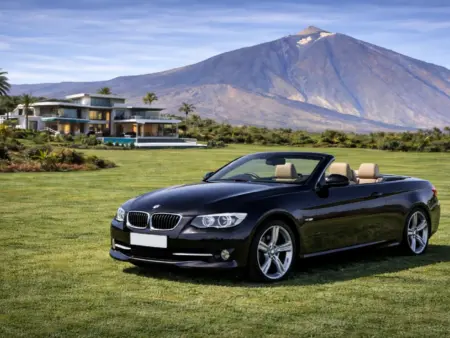
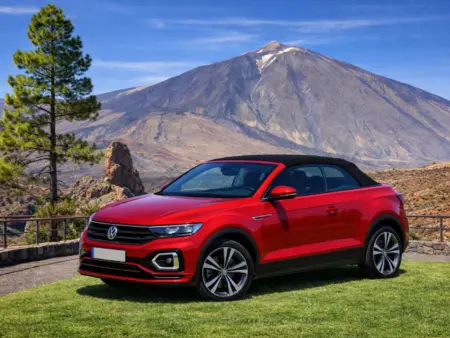
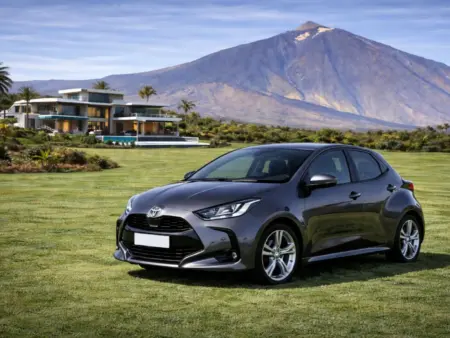
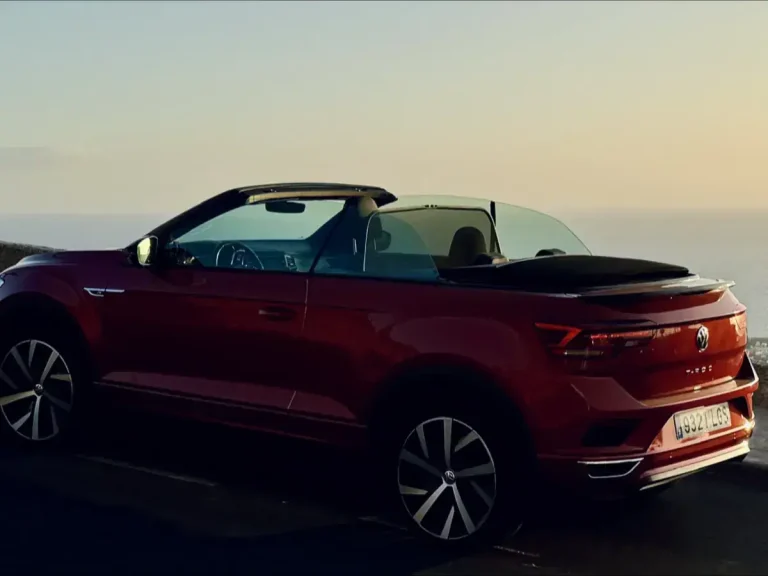
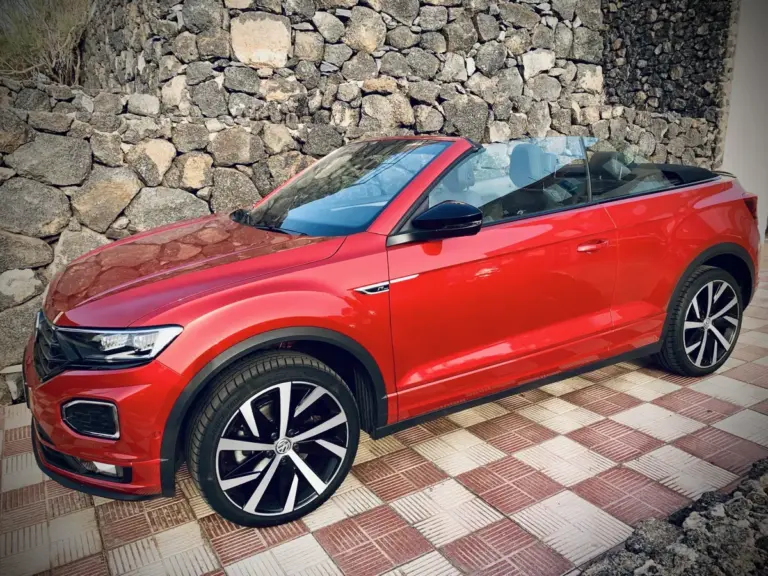
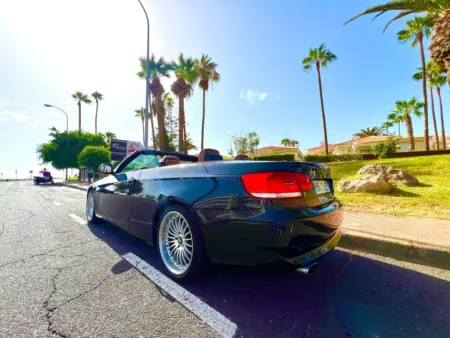
Most of what’s hard about Tenerife’s roads is work for your left foot and right hand on a steep hill. An automatic takes that away. The BMW 320d Cabriolet and the Volkswagen T-Roc Cabriolet R-Line are both automatics; the Toyota Yaris Hybrid is a small automatic hybrid that’s easy to place on narrow roads. [S6] The full open-top range is in our cabriolet category.
FAQ
How do roundabouts work in Spain?
Traffic on the roundabout has priority. Enter from the right lane, drive in the outer lane, and leave from the outer right-hand lane; exiting straight from an inner lane is not allowed as a general rule. [S2] [S3]
What is the speed limit in Tenerife?
For cars: 120 km/h on motorways, 90 km/h on conventional roads, and 50, 30 or 20 km/h in towns depending on the street. Signs take precedence. [S1]
Who has priority on a narrow mountain road in Tenerife?
On narrow sections with a gradient of 7 % or more, the vehicle going uphill, unless it can reach a passing place first. [S1, art. 63]
What is the drink-drive limit in Spain?
0.5 g/l in blood or 0.25 mg/l in breath; 0.3 g/l and 0.15 mg/l for drivers with a licence under two years old. [S1, art. 20]
Sources (checked 2026-10-09)
- [S1] Reglamento General de Circulación, consolidated text (BOE-A-2003-23514), last update published 2026-06-26, in force from 2026-10-01 — arts. 18, 20, 29, 48, 50, 63, 85, 87, 110; checked 2026-10-09.
- [S2] DGT, basic traffic rules for foreign drivers (updated 2026-03-05) — roundabout priority and outer lane, alcohol, drugs, seat belts, child restraints; checked 2026-10-09.
- [S3] DGT, “Glorietas: cómo circular de forma segura” — entering, lanes, leaving from the outer lane, going round again; checked 2026-10-09.
- [S4] DGT, “Autopistas y autovías: las normas para conducir seguro” (2024-10-30) — 120 km/h, keep right, merging; checked 2026-10-09.
- [S5] Mandry Cabrio rental terms, sections 8 and 13 (last updated 2026-08-05) — no insurance cover under alcohol or drugs, respect for Spanish traffic rules; checked 2026-10-09.
- [S6] Car pages on mandrycabrio.com (BMW 320d Cabriolet E93, VW T-Roc Cabriolet R-Line, Toyota Yaris Hybrid) — gearbox; checked 2026-10-09.